
Scientists have found the first direct evidence of a massive underground tunnel buried beneath the scorched surface of Venus, offering new clues about the planet’s volcanic past. The discovery marks a breakthrough in understanding Earth’s “twin planet,” long shrouded by thick clouds that make surface study difficult.
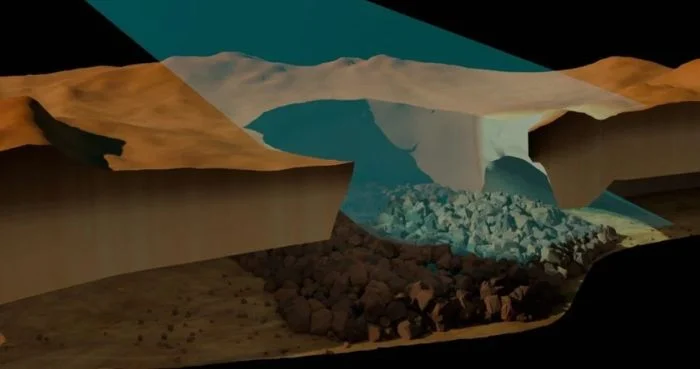
Researchers made the finding by analysing decades‑old radar images from NASA’s Magellan spacecraft. The data revealed a hollow cavern beneath a collapse pit near the Nyx Mons volcanic region that matches the shape of a large lava tunnel.
Finding the Hidden Tunnel
Venus’ dense atmosphere blocks light, so scientists rely on radar to map its surface and geological features. A research team led by scientists at the University of Trento identified a radar signal that suggested open space beneath the ground rather than solid rock.
The structure appears to be a lava tube — a tunnel formed when molten lava flows beneath a hardened crust and later drains away, leaving a hollow channel. Similar lava tubes have been seen on Earth, the Moon and Mars, but this is the first clear sign on Venus.
Size and Characteristics
Early measurements suggest the opening spans about 1 kilometre wide, which is far larger than many lava tubes found on Earth. Its interior rises at least hundreds of metres high, creating a vast underground space.
The roof above the tunnel is thick and solid, helping the cavern remain intact despite Venus’ harsh surface conditions. However, scientists cannot yet determine the full length of the tunnel or whether it connects to other underground networks.
Why It Matters
This discovery is scientifically significant because it validates long‑held theories that Venus’ intense volcanic activity shaped its landscape not only on the surface but also deep underground. Lava tubes could reveal how volcanic processes worked early in the planet’s history.
Future missions slated for launch later this decade, including radar‑equipped orbiters, may explore Venus’ subsurface in more detail. These missions aim to map tunnels and other hidden structures, providing fresh insights into Venus’ internal geology.
What Happens Next?
Scientists hope new high‑resolution radar data from upcoming spacecraft will help confirm whether the tunnel is part of a larger network. These studies may also improve knowledge of how volcanic features evolve beneath extreme conditions like those on Venus.
Conclusion
The discovery of a massive underground lava tunnel beneath Venus’ surface offers a rare glimpse into the planet’s interior and volcanic history. It opens new avenues for research and challenges scientists to rethink what lies beneath one of the solar system’s most mysterious worlds.
For the latest updates on this developing story, stay tuned to Faiz.tv.