
Card payment systems have transformed significantly over the past few decades. The journey from magnetic stripe cards to contactless EMV technology has improved payment speed, convenience, and security for consumers and businesses.
Today, digital payments are a key part of global commerce, driven by advances in technology and growing demand for safer transactions.
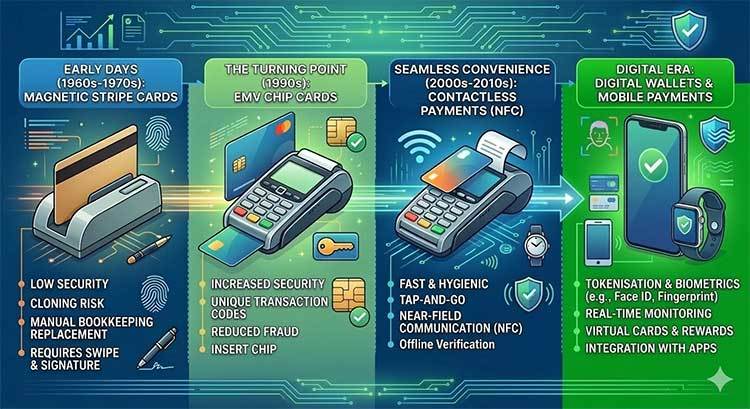
Magnetic Stripe: The Beginning of Card Payments
Magnetic stripe cards became widely used in the 1970s and 1980s. These cards stored payment information on a magnetic strip located on the back.
To complete a transaction, users swiped the card through a reader. The system quickly verified account details and approved the payment.
However, magnetic stripe technology had weaknesses. Criminals could easily copy card data using skimming devices. As fraud increased, financial institutions started searching for safer alternatives.
EMV Chip Technology Improves Security
To address security risks, banks introduced EMV chip cards in the early 2000s.
EMV stands for EMV, a global payment standard developed by Europay, Mastercard, and Visa.
Unlike magnetic stripes, EMV chips generate a unique transaction code for every purchase. As a result, it becomes extremely difficult for fraudsters to duplicate card information.
Users insert the card into a payment terminal and confirm the transaction with a PIN or signature.
Contactless Payments: Faster and More Convenient
The next step in payment evolution introduced contactless technology.
Contactless cards use NFC (Near Field Communication) to complete payments without inserting or swiping the card. Instead, users simply tap the card on a compatible terminal.
This method allows payments to process within seconds. It also reduces physical contact with devices, making it more convenient for everyday purchases.
Contactless payments became especially popular during the COVID‑19 pandemic as consumers looked for safer and faster ways to pay.
Rise of Mobile and Digital Wallets
Modern payment systems have expanded beyond physical cards. Many consumers now use digital wallets such as:
- Apple Pay
- Google Pay
- Samsung Pay
These platforms store card details securely and allow users to make contactless payments using smartphones or smartwatches.
Future of Card Payments
The payment industry continues to evolve with new technologies such as biometric authentication, tokenization, and AI‑based fraud detection.
Financial institutions are also exploring innovations like digital identity verification and blockchain‑based payment systems.
As technology advances, card payment systems will likely become faster, more secure, and increasingly integrated with digital devices, shaping the future of global transactions.